Image Slider

Showing posts with label solo travel. Show all posts

Six Hours in Berlin

March 22, 2016
Mid-February I saw some roundtrip flight tickets to Berlin on for 10 euros. It was too good to pass up, so I decided to just go for it and see Berlin for a short quarter of the day. I was up at 5:30 on Wednesday and travelled for more time than I was on the ground - but it was well worth it. 


Ryanair is a budget airline that usually flies into more secondary city airports, so instead of flying into Berlin's main international airport I landed in Schönefeld (SXF), about 30 minutes by train to the city centre. Luckily Berlin has a super convenient and easy-to-navigate public transport system; so I had no troubles at all figuring the area out. 

First stop was the famous Reichstag building, which was completed in 1894 following German national unity and the establishment of the German Reich (the name of the nation-state at the time; it translates to "German Empire"). Post-WWII, the Reichstag was no longer used for government purposes until restoration in 1999 was complete. 


Next up was a short stroll down through to Brandenburg Gate, an 18th-century arch, which is also one of the best-known landmarks of Germany. What was once a symbol of Berlin and German division during the Cold War became a national symbol of peace and unity following the fall of the Berlin Wall. On top of the gate is The Quadriga, a sculpture representing the Goddess of Victory. Fun fact: the sculpture was held captive in France from 1806 to 1814. Why? I don't know.


Walking down Unter den Linden ("under the linden trees"), a boulevard in the Mitte district.

The Gendarmenmarkt is a square housing the Konzerthaus and the French and German Churches. In the middle of the square (white and pictured in front of the Konzerthaus below) is a statue of one of Germany's renowned poets, Friedrich Schiller.

Neue Kirche (a.k.a. Deutscher Dom, the German Church)

 Konzerthaus Berlin (feat. Friedrich Schiller and his very en vogue robe)

Französischer Dom (a.k.a. French Church of Friedrichstadt)


Unfortunately, St. Hedwig's Cathedral (below) was surrounded by construction, so the only photo I could get from the outside was of the super-angled-and-cut-off variety. You can see a lovely crane reflected in the historical 18th century window. It seems as though Europe is always under construction. 


I popped into St. Hedwig's for a few minutes to have a look around.  

 Humboldt University of Berlin, founded in 1810, is one of Berlin's oldest universities. 

Okay, so I didn't catch the name of this museum...but it has a nice pillared walkway and looks very important (but I guess not important enough for me to learn its name...).


This next building I do know the name of. Below is the Berlin Cathedral (a.k.a. Berliner Dom). It is located on Museum Island, a small island appropriately containing many museums - with the Berlin Cathedral being one of its most travelled-to landmarks. 


The cathedral as you see it now was finished in 1905, with many predecessors. 


Going inside the cathedral wasn't free, so I snuck in for a quick snap of the foyer. Still very impressive.

Another of Berlin's points of interest, seen on almost every postcard, is the Fernsehturm de Berlín - a television tower located just off of the large public square Alexanderplatz. At 365m, it is the tallest building in Germany. However, it was meant to be the tallest in Europe, but is second to Moscow's TV tower. According to urban legend, the 365m height was deliberately chosen so that everyone could easily remember its height, like the days of the year. It costs roughly 13 euros to take an elevator to the top for panoramic views of the city, which I'm sure are amazing. Unfortunately, my time was limited, the line was long, and my pockets are shallow (student struggles).


The Red Town Hall (Rotes Rathaus), close to the TV tower, is seat of the Governing Mayor and the Senate of Berlin. Built between 1861 and 69, the hall derives its name from the façade design made up of red bricks. It really is such a unique building and stands out from miles away. I'm more partial to calling it burnt orange, but "The Burnt Orange" or "Orangey-Red Town Hall" doesn't have the same ring as Rotes Rathaus.


Second last landmark stop was Nikolaikirche, also known as St. Nicholas' Church. The 13th ce. church was ruined by bombs in WWII and has since been rebuilt to no longer function as a church, but as a venue for events, concerts, and organ recitals. 


Nikolaikirche is located in the area of Nikolaiviertel, the reconstructed historical heart of Berlin. This area made me feel as if I transported to a different city or town. The buildings were much more 'cute' and 'old-school', less city-like.


A street in the Nikolaiviertel area.

My last official stop in the city centre was the Bode Museum (originally called Kaiser-Friedrich-Museum) on Museum Island. I didn't have time to visit inside the museum, but wanted to catch a glimpse of another landmark. The museum's concept can be traced back to Crown Princess Victoria of Prussia, who published her ideas in a memorandum in the late 1800's. Her ideas were put into practice when construction began in 1897. The museum opened in 1904. 


On my way to the bus station that would take me to the Berlin Wall's East Side Gallery, I walked past The Neue Synagoge (literally, the "new" synagoge). It was built in 1859–1866 as the main synagogue of the Berlin Jewish community. Even though it's sandwiched among other buildings, the synagoge is still quite the elaborate building and impressive sight. 


My very final stop on this short trip to Berlin was the East Side Gallery, a 1.3 km long section of the Berlin Wall, which acts as an international memorial for freedom and is covered in various art and graffiti. This is the first place that came to mind when I first thought of booking a trip to Berlin. Certain works are kept secure behind fences, while others are completely open - I'm not sure what deems a piece of work "fence-able".


Love this piece showing characters like Batman and The Joker.


The final two pieces of work really stood out to me in light of recent events (such as the bombings this morning at the airport and a few metro stations in Brussels). There is so much to learn from a city such as Berlin and country such as Germany. With a very complicated and horrific past, it seems as though many of the people within this city and country now live to move forward and not look back, which should serve as a lesson for many people and nations elsewhere. We can't let fear and anger decide how we treat others; we are all just people regardless of race or religion.

I hope you enjoyed this Berlin recap. It is no new news that I take forever to put these posts together, so bear with me as I prepare to share my Saturday trip to Luxembourg as well. Thanks for reading!

- Alexandra

Solo in Oslo: Day 2

March 11, 2016
First of all, if you haven't read day 1 yet, then go ahead and click here. Now that you're all caught up, let's jump into day 2. I had to be at Oslo Central Station by 3pm to catch my shuttle to the airport, so I had planned a day featuring a long walk and a few more must-sees for an overall low key day. I hope you enjoy this very picture-heavy post featuring Akerselva, Akershus Castle, and the Oslo Fjord!

 The Oslo Fjord.

My day began at Vaterlandsparken near the bottom of Akerselva (Aker River), just a short walk from Oslo Central Station. A walk along Akerselva is another activity that came highly recommended on Trip Advisor, as it takes you through the district Grünerløkka with waterfalls, bridges, churches, and cute Norwegian streets to detour through. 


This is where the cityscape began to taper off into smaller squares and bright buildings.


Grünerløkka is known for it's graffiti-covered buildings.


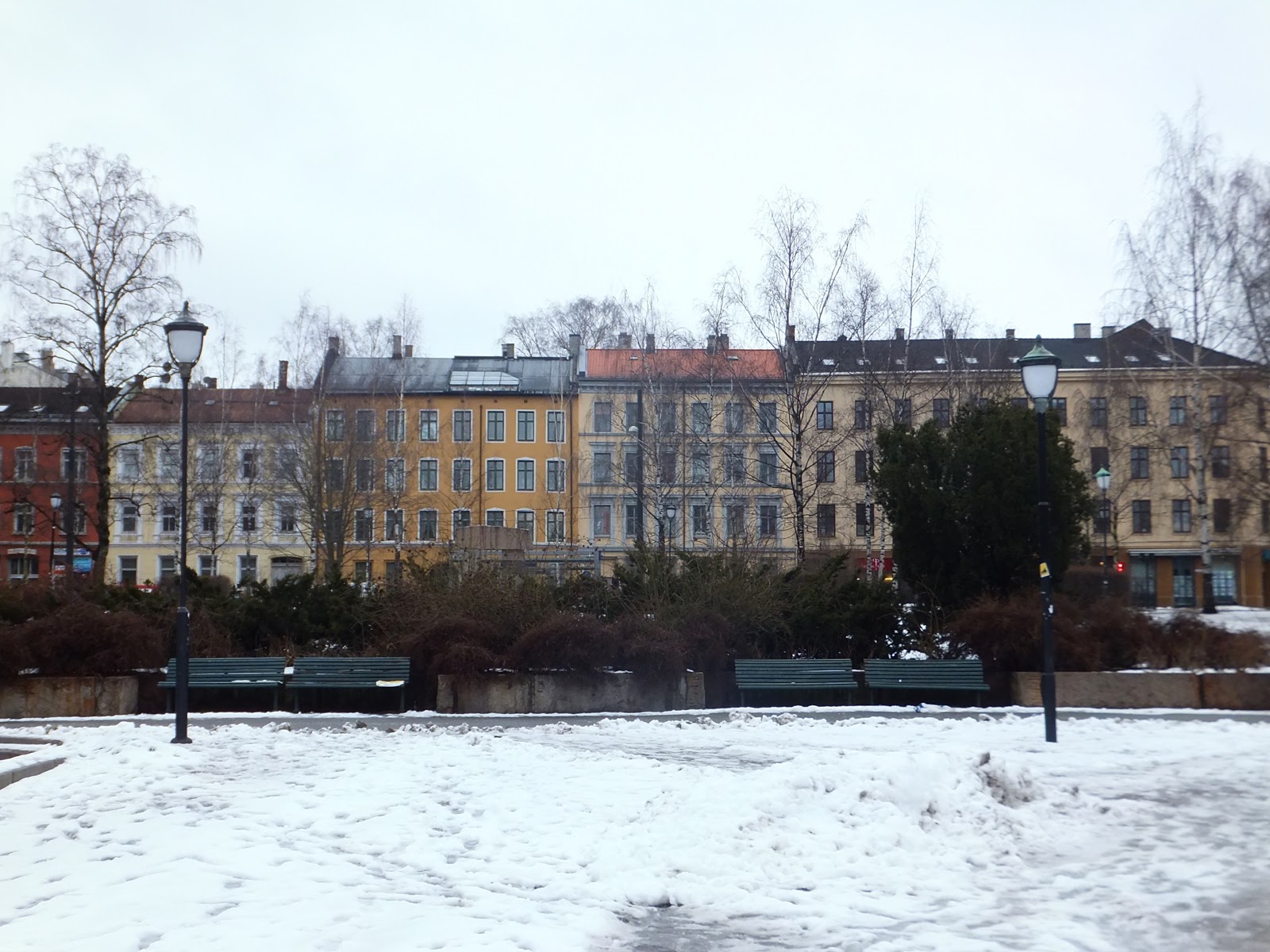
I stopped a little longer in the square of Paulus' plass to appreciate the yellow strips of buildings, gazebo, and Paulus Church.


Paulus Church


Åmodt bro is a pedestrian suspension bridge over the Aker River that was built in 1851. There was a man-made waterfall to the left, but the main attraction is still to come. 


I finally made it to the waterfall at Mølla, next to the very popular Hønse-Lovisas hus café. Unfortunately I made to to the waterfall around 10am and Hønse-Lovisas hus doesn't open until 11am; so I had to pass on the Trip-Advisor-recommended waffles with jam and sour cream. Maybe next time, guys, maybe next time.  

You can see the little red Hønse-Lovisas hus peeking through on the right.

Waterfall at Mølla.

A closer look at Hønse-Lovisas hus.

On this end of the Aker River are two picturesque streets and Old Aker Church, which was where I headed to next. Below is Telthusbakken, a steep street lined with brightly coloured houses that leads right up to Old Aker Church.


Old Aker Church (or Gamle Aker kirke) is Oslo's oldest remaining building and the only remaining church from the Middle Ages. It is assumed to have been built around the year 1150 and is made of stone. The tower was built later on in 1861 and the oldest part of the surrounding churchyard dates back to the 12th century. I was hoping to go for a nice walk around the churchyard, but turns out it's a pretty eerie graveyard...so I decided to let the ghosties chill out in private and headed for picturesque street number two.


View from the top of Telthusbakken near Old Aker Church. 

The next street coming up is definitely my favourite of the two. It's narrow, cobblestone, and so classically Norwegian. If I were to ever live in Oslo this street would be on the top of my "where to live" list.


Every time I read this street name it comes out as "damn straight" in my head. And I'm still just rolling with that.


Following my Grünerløkka excursion I headed back to central Oslo to revisit the Oslo Cathedral (or Oslo domkirke). I had passed the cathedral on day one, but it was closed to the public for a private function; so, I made a mental note to return if I had the time during day two. Luckily my walking plan took way less time than I had anticipated, so I was able to visit three main attractions I had missed the day before: Oslo Cathedral, Akershus Castle, and the Fjord.

Oslo Cathedral


Oslo Cathedral was consecrated in 1697; then, in 1950, it was restored back to its original baroque interior. The pulpit, altar piece, and organ front with carvings are all originals. The ceiling murals were painted in the mid 1900s by Hugo Lous Mohr. The Cathedral is active and used as the parish church for downtown Oslo. The Norwegian Royal Family and Government even use it for many events - fancy Nancy.


Akershus Castle is located within the Akershus Fortress, which I visited on day one, and was open to the public on Saturday afternoon. Everyone is welcome to walk into the courtyard for free, but entrance into the castle itself requires a ticket. I had bought a 24hr Oslo Pass on Friday, which gave me free museum entrance to almost every museum in the city and free public transport, so I could just waltz on in. 

Akershus castle was originally built as a medieval castle around 1300. Its primary function was to defend Oslo. During the reign of Danish-Norwegian King Christian IV (early 17th ce.), the castle was rebuilt in Renaissance style and surrounded by a smaller fortress. The castle began to sort of "fall apart" in the 18th and 19th ce.'s, and has since been restored. Today, its primary function is to house the representation rooms of the Norwegian Government. 


First stop, the dungeon. 

This part of the castle was made into four prison cells early in the 17th ce. Written sources say that one of the cells was known as "the witch's pit". Yikes. 


The Royal Mausoleum, still underground, was next.


In the white marble below is King Haakon VII (1872-1991) and Queen Maud (1869-1938). In the green bronze coffin (tomb? sarcophagus?) is King Olav V (1903-1991) and crown princess Martha (1901-1954). On the opposite side of the crypt (so, to the left in the above photo) are three members of the medieval royal family.

Haakon, Maud, Olav, and Martha just hangin' out. Hopefully in peace.

Just a hallway, but a very pretty hallway.

Next stop, the castle church. This part of the castle has been used for religious purposes since the early 16th ce. It has nearly fallen apart on numerous occasions, but been restored and refurnished. 


The church is in continuous use and acts as the head church of the Norwegian military.

This altar piece is from 1750.


This next room is called "the Daredevil". The areas on the wall made of grey stone are remains from the central tower of the medieval castle known as the Daredevil tower. The tapestries seen hanging in this room are 17th ce. Norwegian bridal tapestries, originally made to decorate the bed on wedding night. 


Night in shining armour.


The East Wing, below, was built much more recently in the 1930s and includes the remains of much older walls. 


One of my favourite rooms in the castle was The Hall of Christian IV. In the 1600s it was divided into smaller rooms used as private apartments for Danish-Norwegian kings and queens. This room is named after the most famous of them, King Christian IV, as he was particularly interested in Norway and visited often. This floor was later made into one large hall. There are three tapestries in this hall, woven in Brussels in the mid 17th ce., which are among the most valuable items in the castle.

The Hall of Christian IV.


A view of the Fjord from a castle window - casual. 

The Prince's Chamber and the Green Chamber, respectively pictured, were originally part of the royal apartments. Today these rooms are furnished to suit their primary function as Government representation rooms - so that explains the lack of bedroom furniture. Most of the items here are 16th and 17th ce. 

The Prince's Chamber.

The Green Chamber.

The Romerike Hall's name derives from the peasants who repaired this wing following a fire in 1527. There are some ghost stories and paranormal experiences that come from this wing; some people have said that the peasants still haunt this place. In the 17th ce. the hall was used by the Governor of Norway and is used today for hosting different functions as it can seat up to 180 people. 


Next, the Margrethe Hall, which is the oldest part of the castle, was the primary living room for members of the court in the middle ages. It is named after the Danish born Queen Margrethe I, who lived at the castle in the mid 1300s. She was married to King Hakon VI of Norway.


Last stop, the Hall of Olav V. This was presumably the location of the great hall of the medieval castle. The present room is a result of the restoration during the 1900s, with interior elements inspired by English and Norwegian originals from the 1300s. The Hall is occasionally used for concerts, theatre performances, and state dinners.


And that concludes our tour of the Akershus Castle. Please don't forget to visit the gift shop on your way out (and feel free to tip the guide).

"Oh hey, didn't see you there."
(Yes, yes this was shot using self-timer)

My farewell stop on this trip was a walk around Aker Brygge and Tjuvholmen, two streets among newer developments by the Oslo Fjord. I really enjoyed this area of Oslo because every single building is beautifully built and complements the boats and harbour in such an interesting way. A nice change from all of the colourful, wooden Norwegian homes outside of the centre.


One does not just go to the Fjord and not take a panorama.


Shoutout to the British tourist who took this for me. You're the real MVP.

And so we have reached the end of my two-day solo adventure in Oslo, Norway. I feel so lucky to have been able to visit a place where my family is from and share it on here with my dad especially. I hope you enjoyed my tour of the city and the many many pictures. I definitely hope to be back some day (when it's greener) and 100% recommend a trip over here - Oslo holds a special place in my heart.

- Alexandra (aka sappy pants)